It’s been such a buzzy space summer, it must have been the IPO bringing in so many new folks. And that is a good thing. It truly is a good thing; More intelligent folks should start seeing the Great Big that is all around the Little Tiny that most people are only able to see around them.
But. Along with the excitement, there has also been a bunch of hype with nifty buzzy words and terms that catch the ear of the brand new folks… while they aren’t always being used in the correct ways. That’s misleading and it isn’t a good way to get people started on the right foot. This is a technical industry after all.
One of those over-hyped and mostly used wrong terms of the moment is: “Mass Driver.”
That term was coined by Princeton professor and particle physicist Dr. Gerard K. O’Neill for a device designed to nearly eliminate the costs of launching dumb masses from Earth by the use of electromagnetic coils and a maglev guideway.
Pause here for a second. That sentence above, the most high-level explanation of the very basic tech of the tool is where fans of pew-pew SciFi start to get things wrong, they think that any EM launcher can be called a “Mass Driver.” But that is Not So. O’Neill didn’t just make another electromagnetic launcher – and inversely, Heinlein and Clarke and Ross and Gatland and even E.F. Northrup didn’t create “Mass Drivers”, the EM ideas had been around a long, long time for weapons and catapults, going back in stories to at least the Hugo Gernsbackian 1920s!
What O’Neill did that was special, that meant that a new and special name was needed as a differentiator from those science fictional guns of the past, was that he made it a machine specifically designed for Mass *Construction*. Construction of really big and important and helpful things made out of lots and lots of tiny little bits.
A “Mass Driver” is a looped machine that would get loaded up with little buckets of regolith or asteroidal detritus, bring them up to wildly extreme speeds then let the *masses* go on their way to a construction area in freespace while – and this is an important part, Elon fans – while those same buckets would slow down, go around a track and pick up more little bits to send off.
Driving Masses to construction locations.
*Mass* Driving.
Hence, “Mass Drivers”.
Sorry Halo fans, sorry Babylon 5 fans, sorry Expanse fans, sorry Elon fans, your entertainers used the term only because they thought it sounded pew-pew neato. A Mass Driver is not a red-rimmed slingshot catapult from Quake 2 to push big AI satellites off the moon, and a Mass Driver is not a shotgun to send wheat one day then boulders the next and humans the next to help Lunie Libertarians get a sovereign nation. A “Mass Driver” is a very specific tool. That is why O’Neill created the very specific name for it: “Mass Driver.”
And, unlike the Halo, Expanse, B5 and SpaceX special effects videos, a Mass Driver is not a play-pretend or “theoretical” thing. We are aware that Wikipedia keeps being incorrectly updated to get that wrong too, but real Mass Drivers have been made in the real world. Granted, not Lunar Mass Drivers or MDREs (Mass Driver Reaction Engines, designed by O’Neill to move big Asteroids by slinging little bits of those asteroids), but they have been made as working prototypes that have proved conclusively the feasibility of the concepts and the velocities that are required to make them truly worthwhile on the Moon or out in the belt.
This making of real things that work is different from prompting an AI to generate a cool video. It is.
On this page you will be introduced to the real things and we’re going to start you with the middle child of the Mass Driver family: “MD2”.
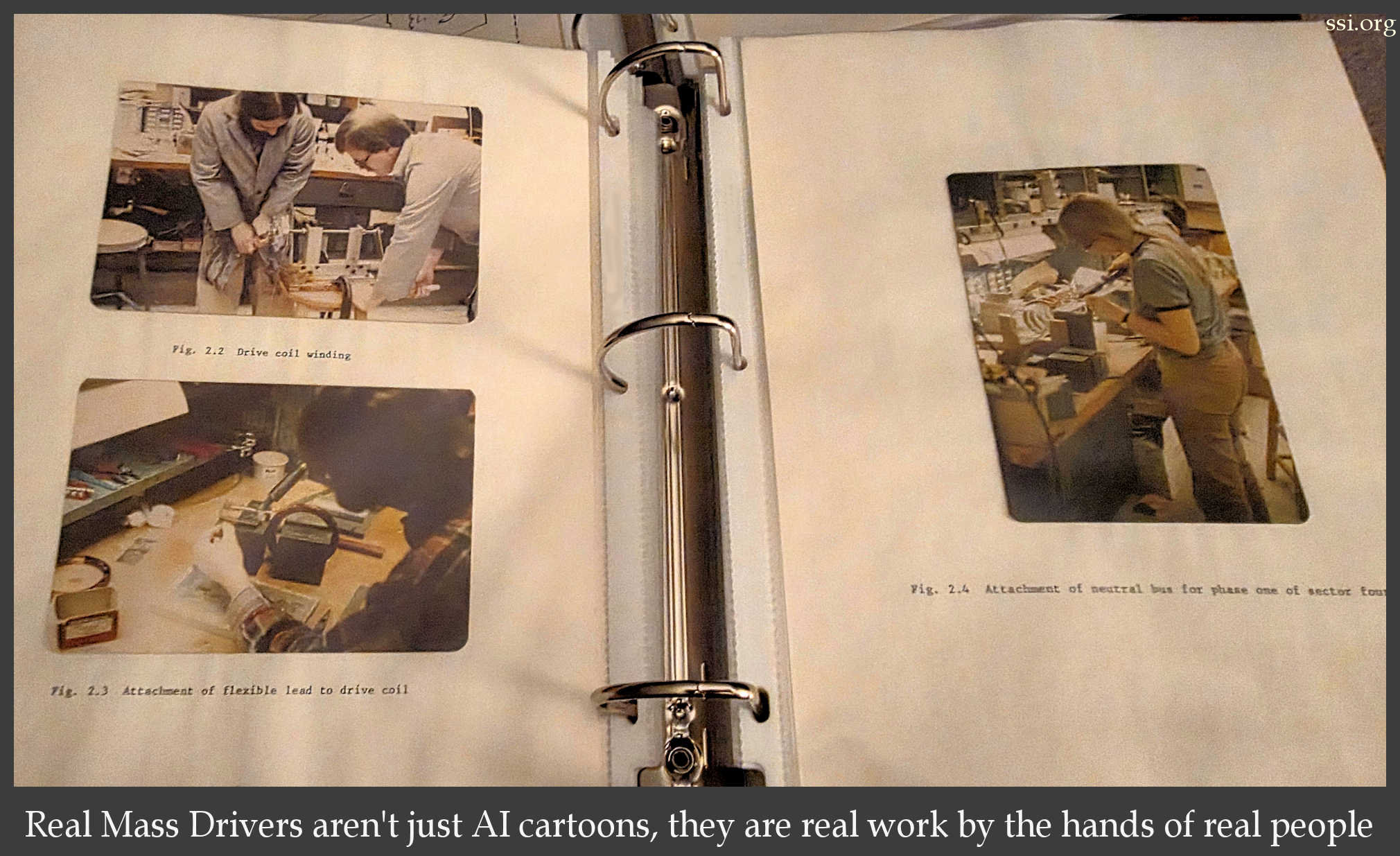
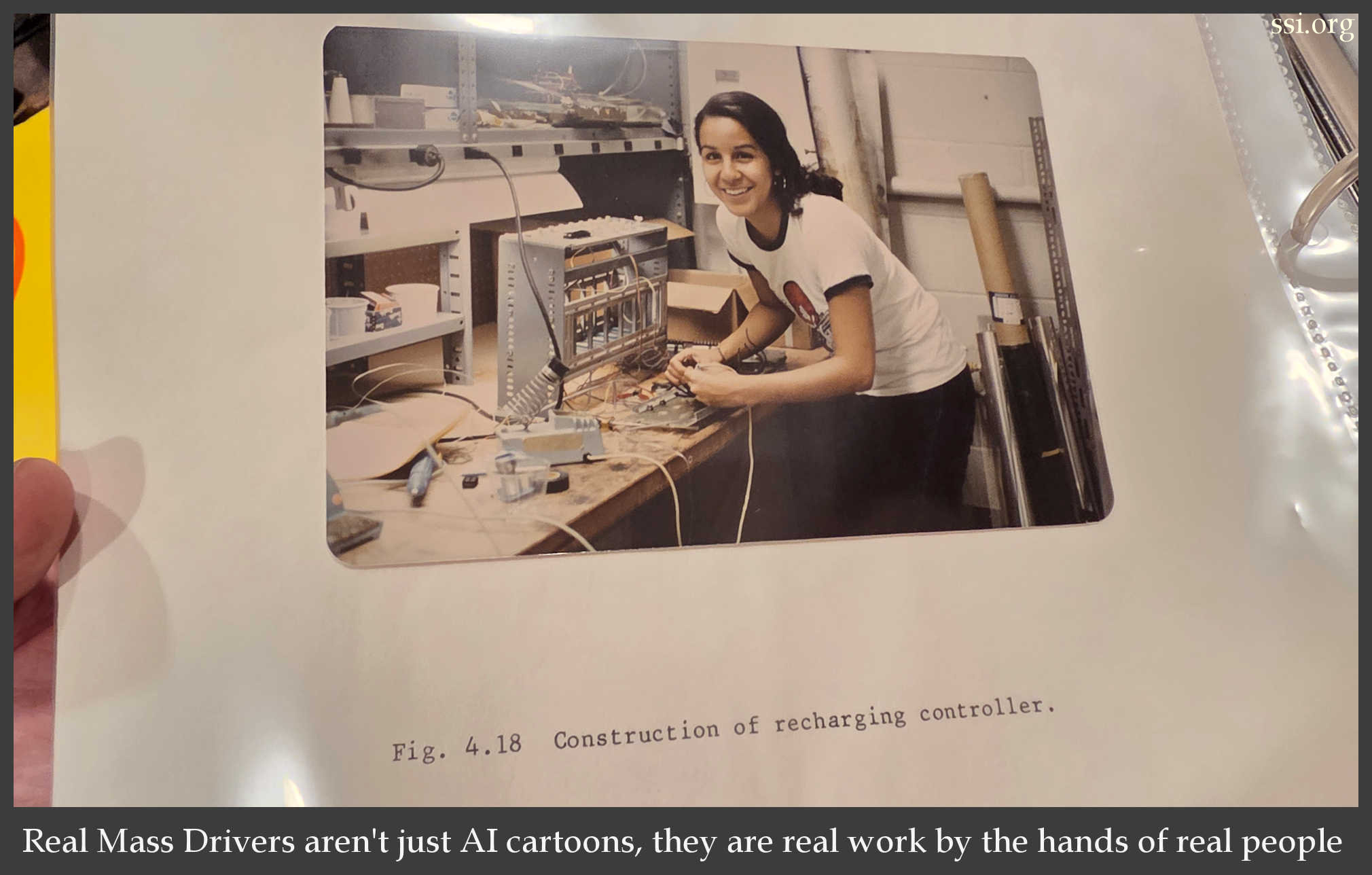
This was the unit that took the lessons of the long wood-sided MIT MD1 built by the Kolm/O’Neill team of Bill Snow, Eric Drexler (yeah, him), Bill Wheaton, Kevin Fine and Jonah Garbus and that hit the documented 33Gs and tweaked it to be smaller and far, far more powerful; MD2 tests hit up into several hundreds of Gs repeatedly.
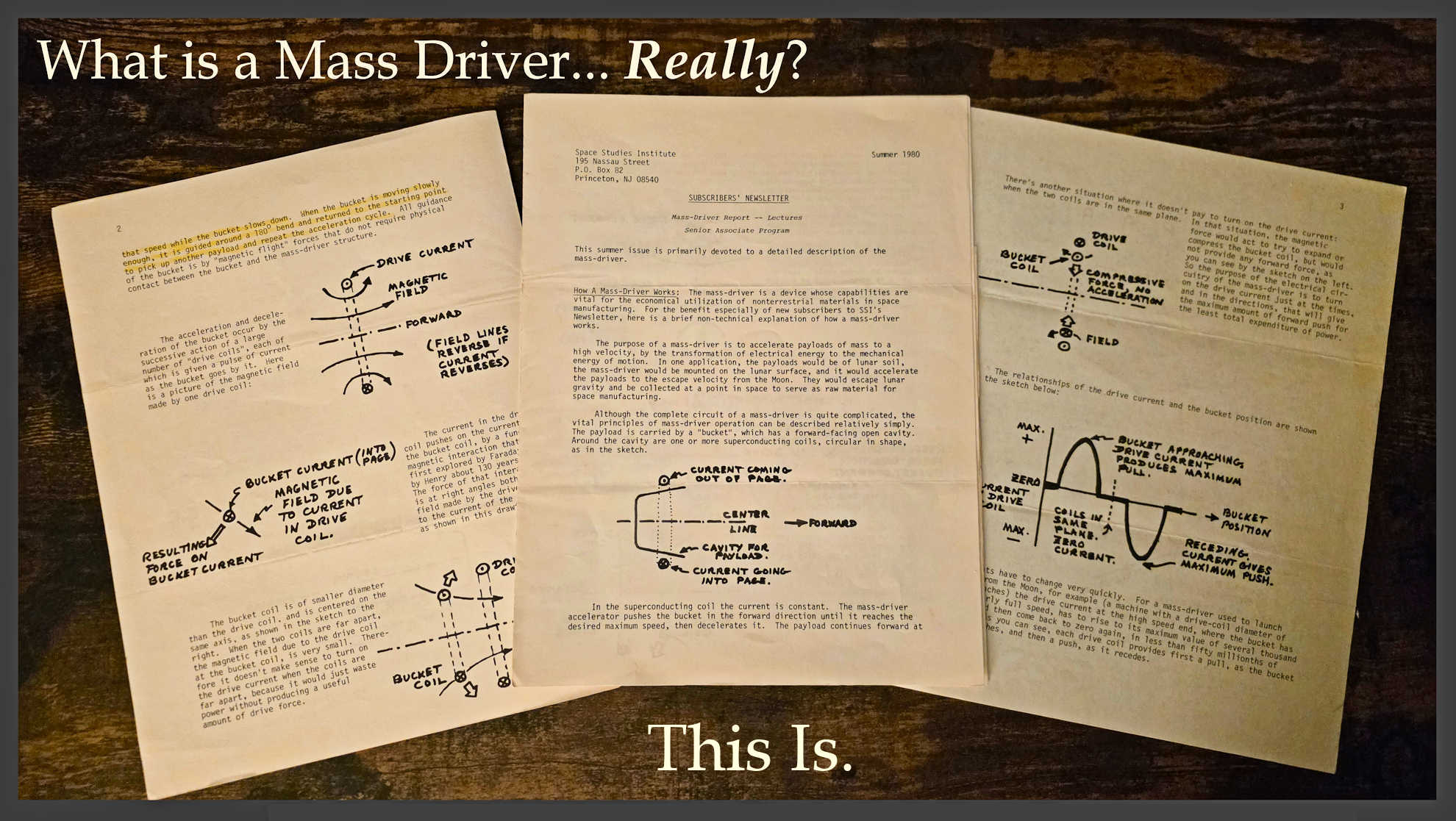
This introduction is very short and sweet. It was written for us regular people to understand and what’s very cool to us at SSI is that it was typed and illustrated by the hand of the man who gave this famous machine its neato name: Dr. Gerard K. O’Neill.
From the Space Studies Institute Archive, never before publicly released, this is the July 1980 Confidential Senior Associate newsletter “How A Mass Driver Works.” It’s an easy 6 pages, you will get a lot out out of it.
Pretty simple, yes?
Ok. Now you have the gist and now we think that you’re ready to see the big kahuna.
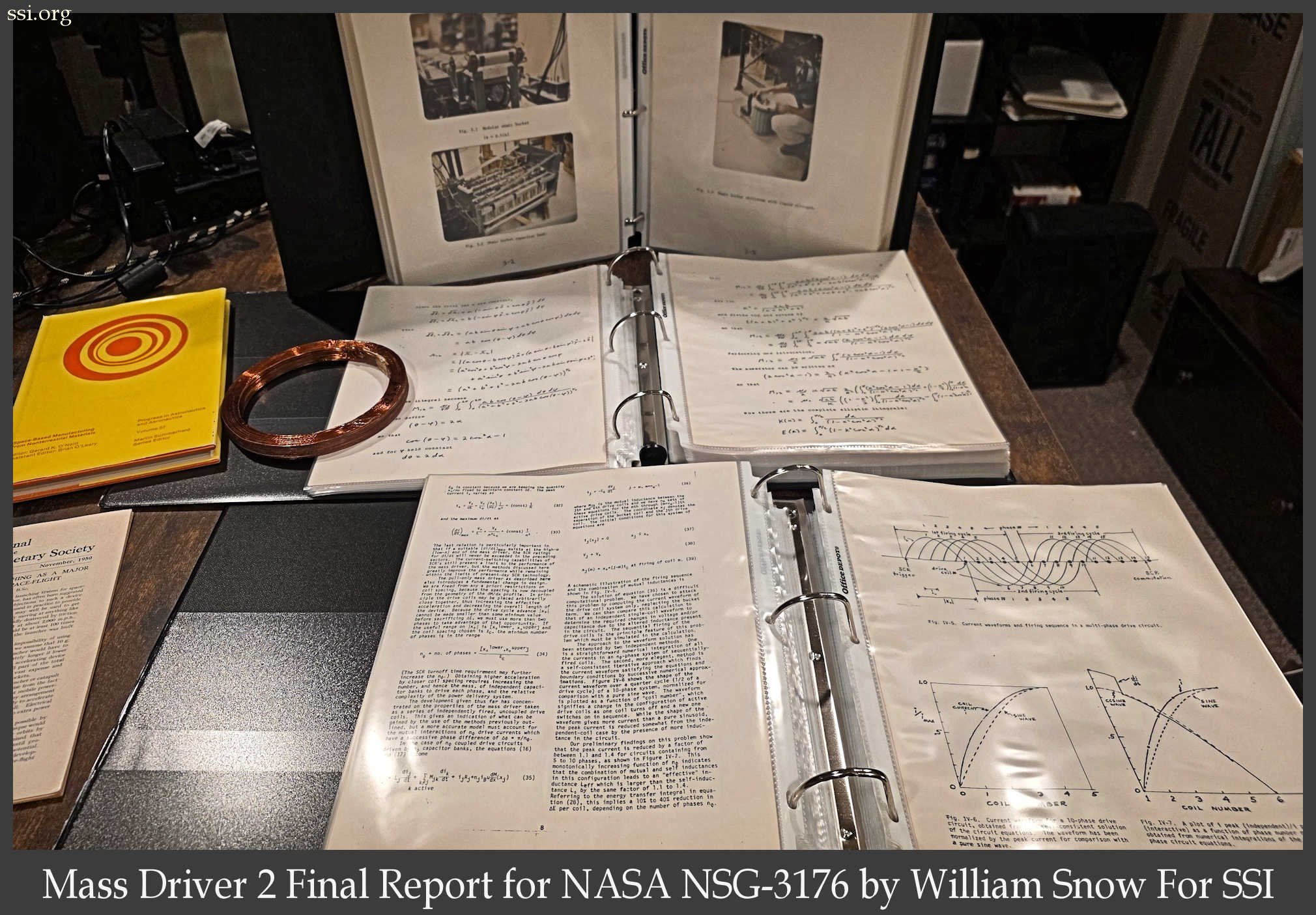
Typed – on a typewriter – by hand on that expensive “resume paper” of the day and with paste-ups of the hand drawn technical schematics and original honest-to-goodness analog photographs of the amazing young people who made the historic hardware… this is the MASTER set of part 1 of 3 of the NASA NSG-3176 Grant Final Report.
What we are releasing for you right here, has never, ever, been seen by the public. Copies, black and white, were sent to NASA as part of the $250,000 SSI hardware process (in 2026 dollars that’s a smidge over a million) and a copy was given to Gerard O’Neill but the one you are about to see has been secured away in the personal collection of the author, the master of the MD2 project, William R. Snow, since its creation 44 years ago.
It is stunning. It is history. It is high technology. It is the documentation of hardware for actual game-changing Space Economics.
We are going to be honest with you here. We have discussed this. It has been raised that many people will skim just the first couple of pages and then “put it off to later.” We Strongly advise you to go deeper than that because, like the old song says, Someday Never Comes. And you should not miss this. Yes, there is high geekdom but there is also very beautiful Humanity in this. We sincerely thank Bill Snow for trusting SSI with this treasure. And we sincerely hope that you will needle-drop many of the pages because we, who have varying levels of technical abilities between us, all have come to the conclusion that anyone with a bit of interest in REAL Space technology will be surprised by how much this truly says.
It’s a space buzzy summer. We are so happy that so many new people are seeing the real value of what starts just 8 minutes up, and with this little post of these historic documents we hope that you are able to see that words do matter. A “Mass Driver” is not just a neato couple of words… it is a specific term for a very important specific way to make Space something that is fundamentally beneficial to all. Or, as that guy O’Neill put it at the beginning of the book The High Frontier:
“Using the Material and Energy Resources of Space to Improve The Human Condition On Earth .”