
Just when the launchers are catching up to the most profitable ideas
The bots are rising to summarize away from you the depths of the importance.
Drop the Slop.
Read the Reals.
For. Your. Self.
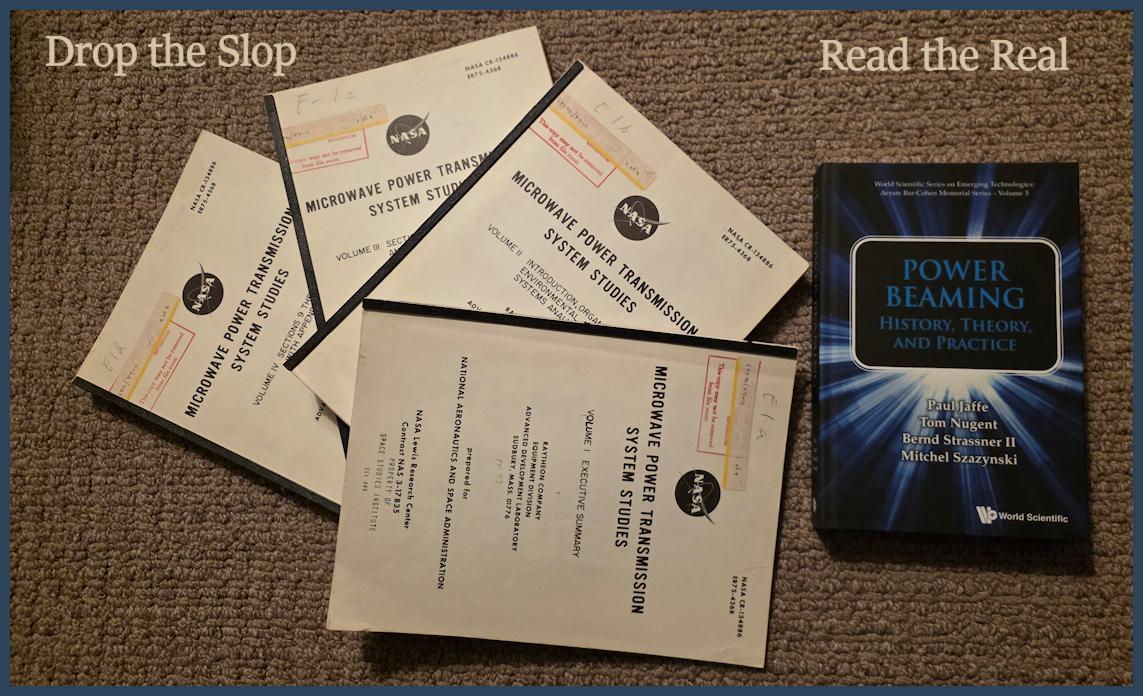
Microwave Power Transmission.
4 from the original masters
1 from the latest experts.
The Original Masters:
A study of microwave power generation, transmission, reception and control was conducted as a part of the NASA Office of Applications joint Lewis Research Center/Jet Propulsion Laboratory five-year program to demonstrate the feasibility of power transmission from geosynchronous orbit.
In four volumes, these are the results.
By Maynard, Brown, Edwards, Meltz, Haley, Howell and Nathan of Raytheon and Grumman.
One:
This volume (1 of 4, 65 pages) serves as an executive summary of results concerning design approaches, estimated costs (ROM), critical technology, associated ground and orbital test programs with emphasis on dc to rf conversion, transmitting antenna, phase control, mechanical systems, flight operations, ground power receiving-rectifying antenna with systems analysis and evaluation. Recommendations for early further in-depth studies complementing the technology program complete the volume.
Two:
This volume (2 of 4, 289 pages) is comprised of Sections 1 through 7 which present introduction, organization, analyses, conclusions and recommendations for each of the spaceborne subsystems. Section 1 presents the Introduction, task definitions, conclusions and recommendations, with discussion of the associated subsystems technologies. It is concluded with a discussion of the report approach and organization. Section 2 presents the organization and approach to the study. Section 3 presents the environmental effects – propagation analyses with appendices covering radio wave diffraction by random ionospheric irregularities, self-focusing plasma instabilities and ohmic heating of the D-region. Section 4 presents the analyses of dc to rf conversion subsystems and system considerations for both the amplitron and the klystron with appendices for the klystron covering cavity circuit calculations, output power of the solenoid-focused klystron, thermal control system, and confined flow focusing of a relativistic beam. Section 5 presents the photovoltaic power source characteristics as they apply to interfacing with the power distribution flow paths, magnetic field interaction, dc to rf converter protection, power distribution including estimates for the power budget, weights and costs. Section 6 presents analyses for the transmitting anteir considering aperture illumination and size, with associated efficiencies and ground power distributions. Analyses of subarray types and dimensions, attitude error, flatness, phase error, subarray layout, frequency tolerance, attenuation, waveguide dimensional tolerances, mechanical including thermal considerations are included. Implications associated with transportation, assembly and packaging, attitude control and alignment are discussed. Section 7 presents analyses for the phase front control subsystem, including both ground based pilot signal driven adaptive and ground command approaches with their associated phase errors.
Three:
This volume (3 of 4, 248 pages) summarizes the efforts and presents recommendations associated with preliminary design and concept definition for mechanical systems and flight operations. Technical discussion in the areas of mission analysis, antenna structural concept, configuration analysis, assembly and packaging with associated costs are presented. Technology issues for the control system, structural system, thermal system and assembly including cost and man’s role in assembly and maintenance are identified. Background and desired outputs for future efforts are discussed.
Four:
This volume (4 of 4, 245 pages) is comprised of Sections 9 through 14 which present receiving antenna, frequency interference and allocation, risk assessment, system analysis and evaluation, critical technology and ground test program, critical technology and orbital test program. Section 9 reviews and discusses the microwave rectifier technology, approaches to the receiving antenna, topology of rectenna circuits, assembly and construction, with ROM cost estimates. It includes analyses and coot estimates for the equipment required to transmit the ground power to an external user. Section 10 presents the analyses and discussion associated with radio frequency interference and allocation. Noise and harmonic considerations are presented for both the amplitron and klystron. Interference limits are identified and evaluated. Section 11 presents the risk assessment discussion wherein technology risks are rated and ranked with regard to their importance in impacting the microwave power transmission system. Section 12 presents the system analyses and evaluation of parametric studies of system relationships pertaining to geometry, materials, specific cost, specific weight, efficiency, converter packing, frequency selection, power distribution, power density, power output magnitude, power source, transportation and assembly. Capital costs per kW and energy costs as a function of rate of return, power source and transportation costs as well as build cycle time are presented. Appendices include estimated annual operations and maintenance cost for 5 and 10 GW systems, systems analysis examples and format for the readers use. Section 13 presents the critical technology and ground test program including objectives, configurations, definition of test Phases I through III and critical technology development with ROM costs and schedule. Section 14 presents the orbital test program with associated critical technology and ground based program based on full implementation of the defined objectives. ROM costs and schedule estimates are included. An appendix is included which provides further detail of the ground and orbital test programs such that the reader may readily modify configurations as studies and technology developments mature leading to modification of the driving objectives.
The New Masters
We said it before on the SSI LinkedIn…
… it bears repeating.
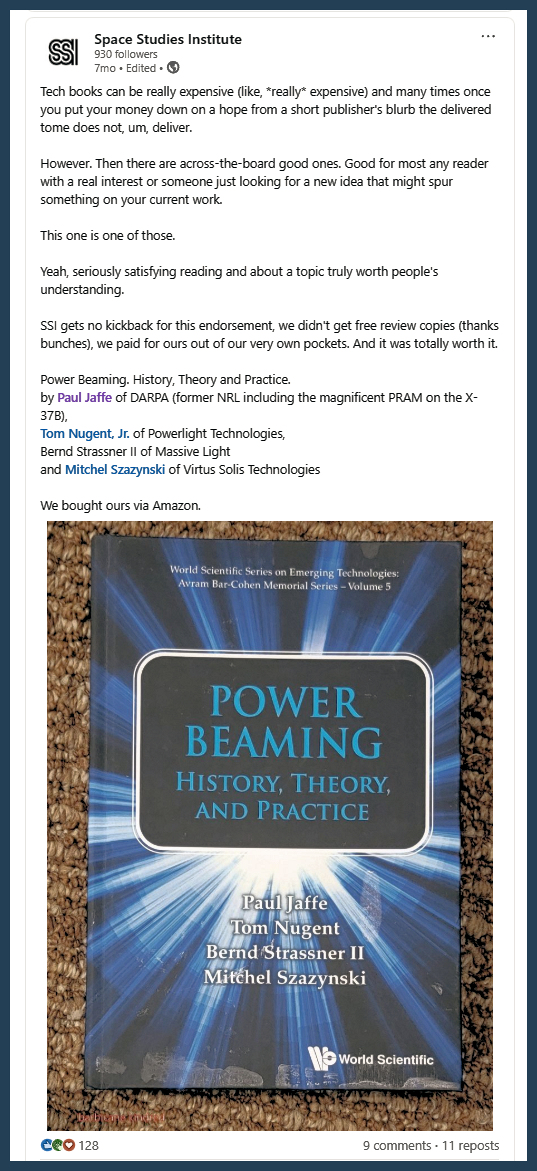
Tech books can be really expensive (like, *really* expensive) and many times once you put your money down on a hope from a short publisher’s blurb the delivered tome does not, um, deliver.
However. Then there are across-the-board good ones. Good for most any reader with a real interest or someone just looking for a new idea that might spur something on your current work.
This one is one of those.
Yeah, seriously satisfying reading and about a topic truly worth people’s understanding.
SSI gets no kickback for this endorsement, we didn’t get free review copies (thanks bunches), we paid for ours out of our very own pockets. And it was totally worth it.
Power Beaming. History, Theory and Practice.
by Paul Jaffe of DARPA (former NRL including the magnificent PRAM on the X-37B),
Tom Nugent, Jr. of Powerlight Technologies,
Bernd Strassner II of Massive Light
and Mitchel Szazynski of Virtus Solis Technologies
We bought ours via Amazon. YOU can too: https://www.amazon.com/Power-Beaming-Scientific-Technologies-Bar-Cohen/dp/9819822424
And the wrap for Humans, the one to one
As we said up there twice, “SSI gets no kickback for this endorsement.” That is true even if you click on the amazon link above to buy a copy for yourself or for a holiday gift. It is just a direct link with no hidden code to cop a secret percentage for this hard-working volunteer organization. No tricks, we do the work with what we have right out in the open.
And all things done take Time and Money… mostly money.
If you *DO* want to show some support for SSI you should do it right out in the open, if you *DO* want to help SSI get by the day to day and do *MORE* than just “get by” and if you *DO* want to get your SSI to get to the real work that we have on deck just waiting to get done… if THAT is what YOU want… then only YOU have the power to MAKE it happen. ONLY YOU.
Capitalization is yelling? I am yelling, it is THAT important to me and it should be to YOU.
Go right here, to THIS page and give generously. We have really big things just ACHING to get started, we NEED your help.
Help! Get a full tax deduction but do it because it is the right thing to do. Now! Right here: https://www.ssi.org/join
Take a quick look right here on SSI.org.